
HOW MEUS WORKS
As a participant at MEUS you can take up one of the following five roles: Member of the European Parliament (MEP), Minister of the Council, Interpreter, Journalist or Interest Representative. As a MEP and as a Minister you will debate and propose amendments on the simulation's two real-life legislative proposals from the European Commission and as an Interpreter you will interpret everything that is being said during the sessions. As a Journalist you will play a vital role in disseminating information regarding the sessions and the topics discussed. As an Interest Representative you will try to influence the legislators with your own devised strategy to push your agenda. Participating in MEUS in any of the five roles will not only help you gain a better understanding of the decision-making process of the European Union, but will also challenge you in multiple ways and assist you in developing multiple different skills, such as public speaking, working as a team under pressure and increasing your negotiation skills!
Political groups in the Parliament will be led by elected Presidents, who are responsible for coordinating discussions in Parliament and outlining political groups' positions on the proposals debated. Effective communication and strategy are crucial in successfully adopting legislation on a European level and both will be necessary at our conference, particularly when it concerns dialogue between the European Parliament and the Council, where finding common ground on the legislative proposals will be necessary for participants to reach their goals. To foster cooperation between the Institutions, formal trilogue meetings between representatives of the Parliament, the Council, and the Commission will be held periodically and will have the primary goal of facilitating discussion across Institutions and seeking common ground on the legislative proposals.
Does all that sound complicated? No need to worry! Participants will be supported by members of the Organising Team throughout the simulation and in the run up to the conference. Moreover, experienced Chairs will moderate debates during the simulation and will maintain order whilst ensuring that all participants have equal opportunities to make their voices heard and contribute to discussions. The presence of Commissioners in our simulation will assist participants in understanding the European Commission's intent behind the specific legislative proposals discussed and will highlight the pivotal role the Institution plays in the Ordinary Legislative Procedure (OLP). Commissioners will will present the legislative proposals in both Institutions and be responsible for conducting the trilogue meetings, ensuring that all participants fully understand the spirit and the technicalities of the proposals discussed. The Legal Service - consisting of members of the Content Team - will check the legality of the amendments proposed by participants and ensure that they abide by EU law and stay within the scope of the conference's proposals. There will also be Political Advisors present at our conference, whose role is to act as a first point of contact for participants, providing support pre-conference and assisting in the drafting of amendments and the development of a coherent strategy throughout the conference.
Although every role has its own unique, specific tasks, everyone must ultimately work and collaborate with each other to bring MEUS to life and create the most realistic simulation of European Union decision-making that there is!
TOPICS DEBATED AT MEUS 2021
Two real-life legislative topics will be debated at MEUS 2021 tying into two prominent topics at the forefront of the European agenda: a European Green Deal and a Digital Europe. Specifically, the two topics debated at MEUS 2021 are:
- a proposal for a Regulation on the Just Transition Fund (see 2020/0006(COD)); and
- a proposal for a Regulation on Preventing the dissemination of terrorist content online (see 2018/0331(COD)).
With the fallout of the COVID-19 pandemic yielding great consequences for the economic prosperity and social cohesion of Europe, the Just Transition Fund will put participants at the heart of deciding the priorities of the European Union as it seeks to balance social justice with climate action as part of European recovery package. Moreover, with our world becoming more interconnected and digitalised than ever, it is vital that Europeans feel secure, safe and comfortable online and that terrorist content is not allowed to spread and endanger citizens. With these two topics at the heart of MEUS 2021, participants are in for hours of tricky debates surrounding two contentious proposals that is bound to create controversy!
ADDITIONAL ROLES AT THE CONFERENCE
Legal Officer
As the simulation of the Ordinary Legislative Procedure (OLP) is highly realistic at MEUS, we choose to work with existing EU legislative proposals to heighten our conference's realism. Our Legal Officers are familiar with the legal terminology of the Directive and the Regulation discussed at MEUS 2020 and are disposed to give legal advice to participants who have concerns about the wording and meaning of certain paragraphs. More importantly, the Legal Team assists MEPs and Ministers when it comes to writing and submitting amendments. Legal Officers review amendments' legal correctness, reject amendments that don´t comply with Union law or are inadmissible for other reasons, and give advice to participants on how to change amendments' wording to make them legally correct and acceptable. The amount of submitted amendments can be extremely high, and Legal Officers are working under pressure to review and digitize the amendments on time to keep the simulation flowing.
Legal Officer
As the simulation of the Ordinary Legislative Procedure (OLP) is highly realistic at MEUS, we choose to work with existing EU legislative proposals to heighten our conference's realism. Our Legal Officers are familiar with the legal terminology of the Directive and the Regulation discussed at MEUS 2020 and are disposed to give legal advice to participants who have concerns about the wording and meaning of certain paragraphs. More importantly, the Legal Team assists MEPs and Ministers when it comes to writing and submitting amendments. Legal Officers review amendments' legal correctness, reject amendments that don´t comply with Union law or are inadmissible for other reasons, and give advice to participants on how to change amendments' wording to make them legally correct and acceptable. The amount of submitted amendments can be extremely high, and Legal Officers are working under pressure to review and digitize the amendments on time to keep the simulation flowing.
Political Party Advisor
Participants who adopt the role of an MEP are assigned to political groups that accurately reflect the current composition of the European Parliament after the elections in 2019. Political Advisors assist MEPs with their pre-conference preparation and during the simulation itself to act as their first point of contact for any doubts relating to the simulation, provide them with plenty of tips for their debates and amendments, assist them with identifying and pushing a common party line and ultimately make sure that all MEPs get the most out of the conference
Political Party Advisor
Participants who adopt the role of an MEP are assigned to political groups that accurately reflect the current composition of the European Parliament after the elections in 2019. Political Advisors assist MEPs with their pre-conference preparation and during the simulation itself to act as their first point of contact for any doubts relating to the simulation, provide them with plenty of tips for their debates and amendments, assist them with identifying and pushing a common party line and ultimately make sure that all MEPs get the most out of the conference
Commissioner
The European Commission is composed of the College of Commissioners of (currently) 28 members, including the President and Vice-Presidents. The Commissioners, one from each EU member state, are assigned for specific policy areas by the President. In the simulation, two organisers from the content team will act as Commissioners for the chosen topics of MEUS 2020. They will present the real-life proposal for a Directive concerning „Environment and Sustainability“ and the Regulation concerning the „Digital Single Market“ to both the Council and the European Parliament. As our Commissioners have been selected from our team's content officers due to their exceptional preparation and knowledge of the proposals, MEPs, Ministers, Lobbyists and News Editors/ Video Journalists are all invited to challenge them with in-depth questions relating to the topics and specific paragraphs of the legal texts. Participants should always keep in mind that while Commissioners are a great source of information and expertise, they too themselves play a role during the conference: representing the Commission, whose role is to act in the interests of the European Union as a whole. As a result, they might seek to influence the conference in their own ways and are likely to lobby for the proposal to fit their own agenda. Ultimately, the Commission wishes to pass both proposals through the Council and the EP in their current state!
Commissioner
The European Commission is composed of the College of Commissioners of (currently) 28 members, including the President and Vice-Presidents. The Commissioners, one from each EU member state, are assigned for specific policy areas by the President. In the simulation, two organisers from the content team will act as Commissioners for the chosen topics of MEUS 2020. They will present the real-life proposal for a Directive concerning „Environment and Sustainability“ and the Regulation concerning the „Digital Single Market“ to both the Council and the European Parliament. As our Commissioners have been selected from our team's content officers due to their exceptional preparation and knowledge of the proposals, MEPs, Ministers, Lobbyists and News Editors/ Video Journalists are all invited to challenge them with in-depth questions relating to the topics and specific paragraphs of the legal texts. Participants should always keep in mind that while Commissioners are a great source of information and expertise, they too themselves play a role during the conference: representing the Commission, whose role is to act in the interests of the European Union as a whole. As a result, they might seek to influence the conference in their own ways and are likely to lobby for the proposal to fit their own agenda. Ultimately, the Commission wishes to pass both proposals through the Council and the EP in their current state!
Secretary
Secretaries are there to assist the four chairs in both institutions. They make sure that the technology is set up, take care of the speakers list and every document is displayed at the right time.
Secretary
Secretaries are there to assist the four chairs in both institutions. They make sure that the technology is set up, take care of the speakers list and every document is displayed at the right time.
THE ORDINARY LEGISLATIVE PROCEDURE
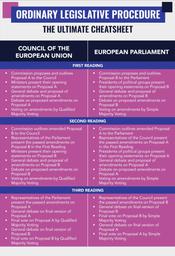
The Ordinary Legislative Procedure of the European Union (OLP) refers to the system where the vast majority of the European laws are adopted giving an equal weight to the European Parliament and the Council of the European Union in the decision-making process. Under the OLP, the European Commission publishes a proposal for a Directive or a Regulation (see below). The Parliament and the Council discuss these proposals in three separate readings. (Further information on how this procedure works in the real EU institutions is available on this webpage of the European Parliament).
For the sake of making our simulation realistic within the one-week time span, we implement a simplified version of the OLP. During the first two readings, taking place over two days, both institutions will separately debate the legislative proposals. Before the voting period during which the proposals are accepted or rejected, MEPs in the Parliament and Ministers in the Council undergo the first reading of the proposals and propose amendments to the text which will then be discussed among all the members of their respective institutions. Proposed amendments will be accepted by a simple majority in the Parliament and a qualified majority in the Council and are then integrated into the legislative text which will go to the other institution for a second reading. The other institution will then discuss the legislative proposal comprising the passed amendments.
During the second reading, the institutions will propose, debate and vote upon their own amendments in turn. During the third and final reading, the ultimate version of the legislative texts, as amended by both institutions, will be discussed. After the debate on the final version of the text, both institutions will vote to either accept or reject the complete legislative proposal. If the proposal is accepted, it shall then be a secondary legislative act of the European Union and become binding for all Member States from thereon.
Unless you participate as a Chair, News Editor/Video Journalist, Lobbyist or Interpreter, you are not allowed to bring a laptop or tablet to the European Parliament. There is also no Wifi connection available.
We encourage you to prepare well and have the directive,regulation and provided guides printed out to work with at the conference.